
Email: sales@simple.works
Indian banking has always been defined by scale. Crores of customers. Lakhs of field agents. Thousands of branches. But even with this massive reach, most institutions still run on processes that were designed years ago long before customer expectations, digital behaviours, and regulatory demands became what they are today.
That’s why this moment feels different. The world is moving towards systems that don’t just process tasks, but take decisions, act on them, and improve with every cycle. And Indian banks and NBFCs are standing right at that crossroads, wondering how to make this shift without breaking their existing foundation.
This is where Agentic AI starts becoming more than a concept.
It becomes a very practical way to rethink the way financial operations work.
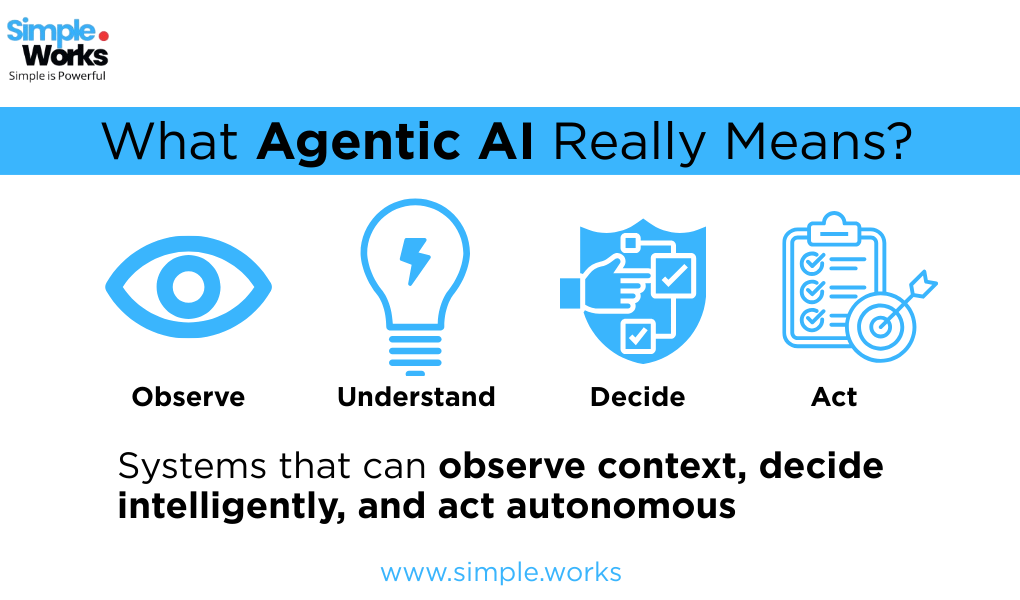
For many, AI still means dashboards, chatbots, and models that predict numbers on spreadsheets. But Agentic AI is a different layer of intelligence. It’s the ability of a system to observe what is happening, understand context, decide what to do next, and carry out that action without a human nudging it every few minutes.
In simple terms: It’s technology that doesn’t wait for instructions.It moves with you.
Banks have always had software, automation, workflows, and rules. But none of these systems can adapt to customer behaviour, learn from past outcomes, or take initiative when something goes off-track.
Agentic AI can. And this difference changes everything especially in a country as large and operationally complex as India.
The Indian financial ecosystem has a personality of its own. It’s fast-growing, heavily regulated, and deeply diverse. But beneath this progress is a very real operational reality:
Even the most forward-thinking banks live with these gaps. And as loan volumes rise, these gaps only grow larger. This is why autonomy matters. Not for the sake of technology but because traditional systems simply cannot keep pace with the speed and precision required today.
Agentic AI fits directly into this gap. It steps in where processes slow down, where rules alone can’t handle exceptions, and where human teams are stretched thin.
The impact is not abstract. It shows up in day-to-day work. In collections, it understands which customers are likely to pay and reaches out in the right manner rather than sending the same message to everyone. In underwriting, it reduces back-and-forth by evaluating documents, detecting patterns, and preparing decisions faster. In compliance, it catches anomalies early instead of leaving everything for end-of-month checks. In customer service, it anticipates needs instead of reacting late.
What makes this valuable is not the “AI” label, it’s the consistency. Banks and NBFCs no longer rely on manual interventions to keep operations moving. The system takes the small but important decisions that usually consume teams every day. This builds reliability. And reliability at scale is what Indian financial institutions need most.
Most AI products in the world assume perfect data, uniform customer behaviour, and simple journeys. India is the opposite.
Agentic AI doesn’t require everything to be perfect on day one. It adapts to the environment. It learns from the way Indian teams operate. It can work with ground realities, not ideal conditions. This makes the shift realistic instead of overwhelming.
There’s a fear that autonomy might replace jobs. But the truth is far simpler: Agentic AI replaces tasks, not people.
Teams spend less time following up, checking files, correcting errors, or repeating the same actions. They spend more time on work that demands judgment negotiation, risk understanding, relationship-building, and strategic decisions. The organisation becomes sharper without losing its human backbone. That is the right balance.
Every institution wants autonomy. But autonomy needs a stable operational foundation.
Most banks are not starting from scratch; they already have CRMs, core systems, field apps, and workflows.The challenge is connecting everything into a single, reliable flow where AI can actually act.
This is where SimpleWorks plays a meaningful role.
SimpleWorks creates the environment where Agentic AI can operate safely and effectively:
Once this structure is in place, autonomy stops being an experiment; it becomes a natural extension of your operations.
The advantage is simple: You get modern intelligence without disrupting what already works.
Every transformation in Indian banking has started with one realization the systems we built yesterday can’t carry us into tomorrow. The next decade will belong to institutions that combine human expertise with intelligent automation that can act on its own.
Agentic AI is not the future in theory. It is the practical next step for Indian banks and NBFCs that want to scale faster, operate cleaner, and deliver experiences that match the expectations of today’s customers.
The opportunity is right here. And the institutions that take the first step now will lead the next wave of lending and financial growth in India.
If you are exploring how autonomy can fit into your current systems without disrupting your workflows or increasing complexity, SimpleWorks is designed exactly for that transition.
It helps you move from manual-heavy processes to intelligent, stable, and adaptable operations. If you want to see what that looks like for your bank or NBFC, the conversation is open.
