
Email: sales@simple.works

Wholesale Resilience: Why Treasury Ops Needs “SLA Thinking”
In the high-stakes world of wholesale banking, liquidity events are the ultimate stress test. Whether it is a scheduled ₹3 trillion RBI injection or a sudden repo auction, the market window is unforgiving.
For the Head of Treasury, the strategy is set. The bids are priced.
But for the CIO and Head of Operations, the real anxiety isn’t about the yield it’s about the pipe.
In 2026, liquidity is no longer just a financial metric; it is a technology problem. When trillions move through the system in tight auction windows, a 10-minute database lock or a failed API handshake isn’t just an IT ticket. It is a missed market opportunity that shows up directly on the bottom line.
The question for Ops Leaders: Is your back office resilient enough to catch the wave?
The volatility of recent years has taught us a brutal lesson: Market access is binary. You are either online and trading, or you are offline and sidelined.
In a high-velocity OMO (Open Market Operation) or repo auction, the “Trade” is the easy part. The operational risk lies in the chain reaction that follows:
If this relay race stumbles specifically between the Treasury front-end and the Settlement back-end, you risk Settlement Failure. In the eyes of the regulator, a tech failure during a liquidity window looks indistinguishable from a liquidity crisis.
Historically, “Uptime” and “SLAs” (Service Level Agreements) were metrics for Retail Banking apps. If the retail app was down for 5 minutes, Twitter complained. If the Treasury system lagged for 5 minutes, traders just shouted.
That mindset is obsolete. In the era of algorithmic trading and instant settlement, Treasury Ops needs SLA Thinking.
Your internal systems must treat the Treasury Desk as a high-priority “customer” with guaranteed performance metrics.
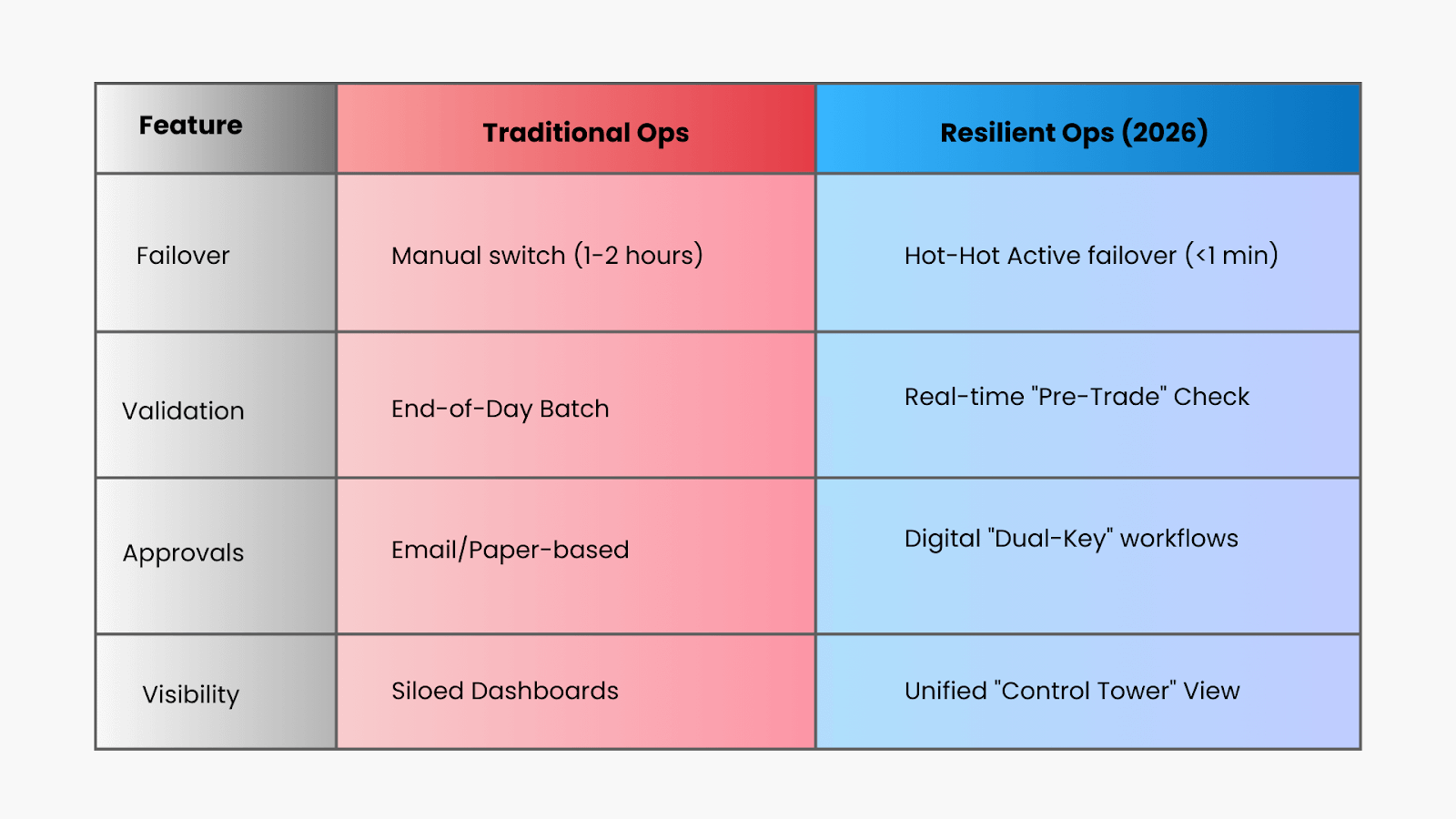
Speed cannot come at the cost of control. The sheer volume of modern liquidity injections means manual confirmations are a bottleneck.
Leading institutions have moved to Automated Orchestration for high-value governance.
We are moving inexorably toward a T+0 settlement environment. The regulator has signaled it, and the technology allows it.
Every current liquidity cycle is a practice run for that future. If your systems strain to settle T+1 volumes today, they will break under T+0 pressures tomorrow. The “End of Day” buffer is disappearing. Your reconciliation logic needs to shift from “Overnight Batch” to “Streaming.”
The banks that win in this cycle won’t necessarily be the ones with the cleverest traders. They will be the ones with the most reliably boring back offices.
The mandate for the CIO is clear: Stability is your Alpha. Ensure your pipes are wide enough, your controls are automated, and your failovers are tested.
Don’t let a timeout error cost you your position.
For more information, please contact us at sales@simple.works
