
Email: sales@simple.works

The era of the “creative” chatbot is over. 2026 is the year of the reliable coworker.If you’ve been tracking enterprise AI spend, you’ve likely noticed a quiet but massive shift in the data. According to recent 2025 reports from Menlo Ventures, enterprise spending has flipped. For the first time, “reliable” models (like Anthropic’s Claude) have overtaken generalist counterparts in critical enterprise workloads, capturing over 30% of market share.
Why the migration? Because BFSI leaders stopped looking for AI that can write poetry and started paying for AI that can follow instructions.
For CIOs and AI leaders in the financial sector, this signals the end of the “Pilot Phase” and the beginning of the Agentic Era. But moving from a chatbot that talks to an agent that works requires more than just a better prompt. It requires a fundamental change in architecture.
In 2023, the biggest risk was a chatbot “hallucinating” a fact, telling a customer that a credit card had zero fees when it didn’t. Bad, but manageable with disclaimers.
In 2026, as we deploy autonomous agents, the risk has evolved. Agents don’t just output text; they execute API calls. They move data, update CRMs, and trigger workflows.
Text Hallucination: The AI says it transferred the funds.
Action Hallucination: The AI actually transfers the funds to the wrong account.
You cannot solve action hallucinations with a “better prompt.” You solve them with architecture.
The primary reason enterprises spend is moving toward models like Claude 3.5/4.0 is their ability to separate reasoning from acting.
In the old architecture (2024), an LLM went straight from Input to Output.
In the new Agentic Architecture (2026), we introduce a “Thinking Loop”:
Input > Plan > Reason/Critique > Tool Use > Output
Before the agent touches your core banking system, it generates a multi-step plan. It then “critiques” that plan against your business rules (e.g., “Does this transaction exceed $10k? If yes, pause.”). Only after this internal validation does it trigger the API. This latency seconds of “thinking” is the price of reliability, and for the BFSI sector, it is a bargain.
We often hear about “Human-in-the-Loop” (HITL), but in a high-volume transaction environment, having a human review every output is impossible. It defeats the purpose of automation.
The 2026 standard is Human-on-the-Loop (HOTL).
In this model, the agent runs autonomously for 95% of tasks (Tier 1). However, the architecture includes rigid “control gates” for high-stakes actions (Tier 2).
Low Stakes (Autonomous) “Update customer address in CRM.” : Agent executes immediately.
High Stakes (Gated) “Initiate wire transfer $5,000.” : Agent drafts the payload, pauses, and pings a human manager via Slack/Teams for a one-click approval.
The agent does the work; the human provides the “key turn.” This satisfies compliance requirements without creating a bottleneck for routine tasks.
Many organizations make the mistake of handing an API key directly to a developer and saying, “Build an agent.” This is a security nightmare.
To deploy agents safely, you need a distinct Orchestration Layer that sits between your LLM and your Enterprise Data.
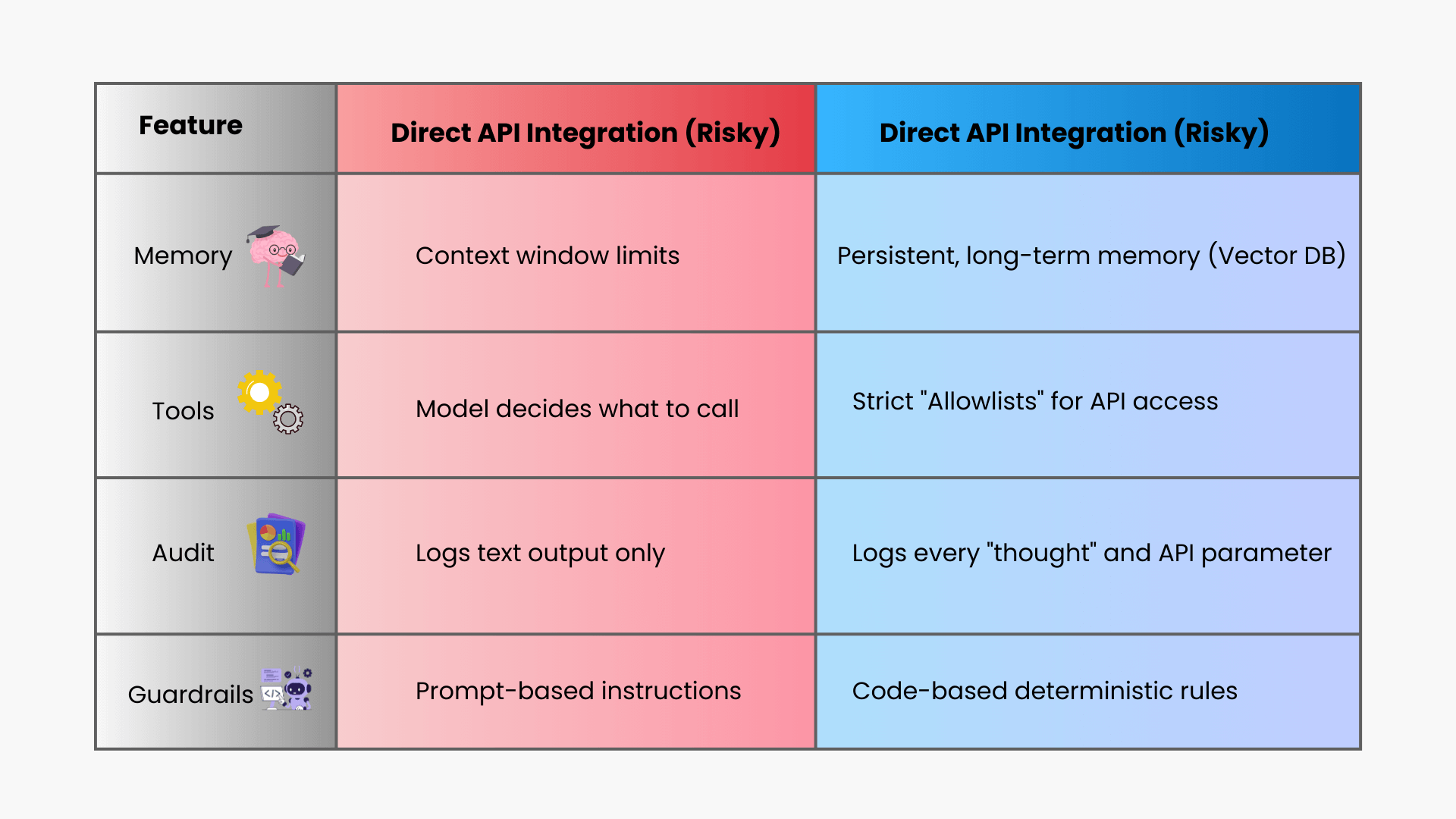
This layer acts as the “frontal cortex” of your AI workforce. It ensures that no matter how “creative” the model tries to get, it can never violate the hard-coded laws of your compliance framework.
The shift in enterprise spend isn’t a fad; it’s a flight to quality. As a CIO, your goal for 2026 isn’t to buy the smartest model; it’s to build the safest architecture. By implementing “Thinking Loops” and “Human-on-the-Loop” governance, you transform AI from a risky novelty into a trusted coworker.
Implementing this architecture from scratch is complex, but for financial institutions, it is non-negotiable. This is why we built SimpleWorks.
Unlike generalist platforms, SimpleWorks is purpose-built for the BFSI sector. We have natively integrated the orchestration layers, thinking loops, and governance gates required to handle high-stakes financial data. With SimpleWorks, you don’t just get an agent; you get the secure infrastructure to manage it.
Stop building the safety net and start deploying the workforce. Partner with SimpleWorks to drive your 2026 strategy with confidence.
