AI Strategy·5 min read·October 9, 2026
Sovereign agentic AI: why regulated banks keep AI inside their own walls
Bank AI pilots often stall at the risk committee because customer data leaves the bank. Sovereign AI runs on-premise, in private or sovereign cloud, or air-gapped, and answers only from approved documents.
SM
Swapnil Manwatkar
SimpleWorks
KEY TAKEAWAYS
- Most enterprise AI sends bank data to someone else's cloud. That is why many AI pilots in banking stall at the risk committee.
- Sovereign AI runs where your data already lives: on-premise, private cloud, sovereign cloud or fully air-gapped.
- Grounded AI (RAG) answers only from your approved documents and says “I don't know” when it can't, which is what makes it approvable in regulated work.
- At Punjab & Sind Bank, an assistant running in the bank's own cloud reached nearly 95% adoption across 4,000+ users and handled 75,000+ questions in production.
Ask a bank's security team about a new AI project and the first question is rarely "how smart is it?" It is "where does our data go?"
For most enterprise AI, the answer is somewhere else. Prompts, documents and customer records travel to a model hosted in someone else's cloud, often in another country. For a retailer, that may be an acceptable trade-off. For a regulated bank or insurer, it usually ends the conversation.
In our conversations with banks and insurers across Asia, the Middle East and Africa, the question has shifted from which AI to buy to whether they can run AI inside their own environment, on their own terms. That is what we mean by sovereign agentic AI.
The trade-off most AI forces on banks
Banks hold some of the most sensitive data any organisation handles: identity documents, account histories, credit decisions, complaints, collections conversations. In the institutions we work with, risk and compliance teams want to know where that data is stored, who can reach it and how every decision touching it can be explained, because their own supervisors ask them the same questions.
Public-cloud AI services make that harder in three ways.
- Data leaves the perimeter: To get an answer, the question and its context are sent outside. Even with contractual safeguards, the bank's data is now processed on infrastructure it does not control.
- Answers are hard to trace: A general-purpose model answers from what it learned in training, plus whatever is in the prompt. When it is wrong, it can be confidently wrong, and there is often no source document to point to.
- Residency rules get complicated: Many institutions operate under requirements that certain data stay within national borders or within approved infrastructure. A model hosted elsewhere does not fit neatly into that.
As a result, many promising proofs of concept never reach production, because risk, compliance and IT cannot sign off on where the data goes.
What "sovereign" actually means
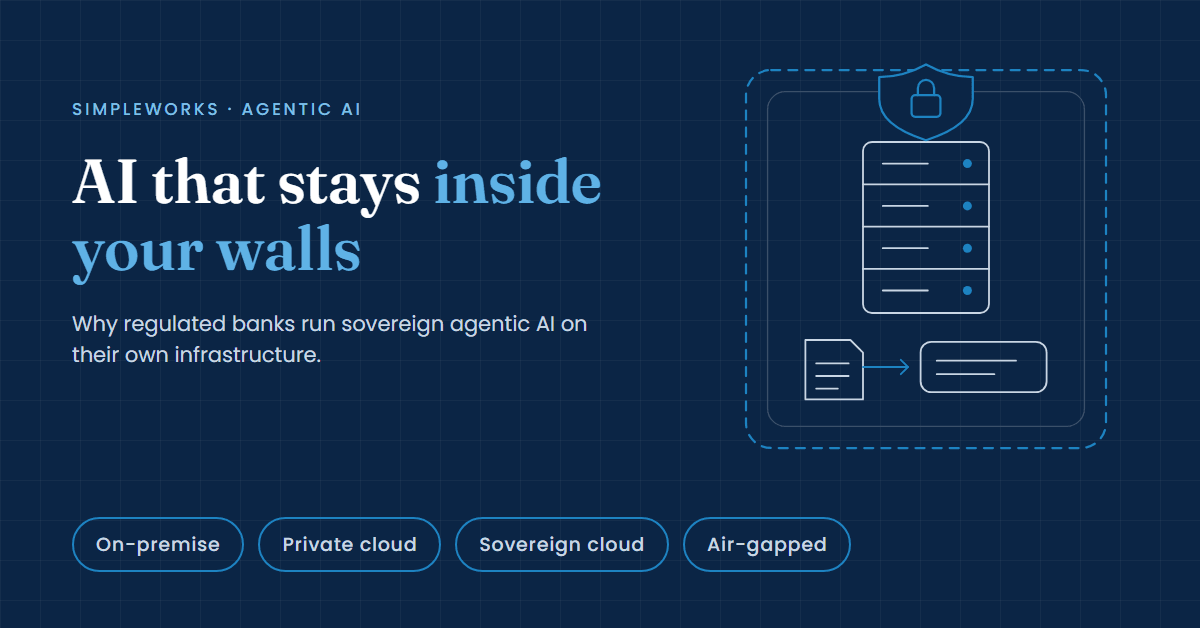
Sovereign AI runs where your data already lives, under your control. SimpleWorks supports four ways of doing that.
- On-premise: Runs on your own servers, in your own data centre. Choose it for full control over hardware, operating system and network.
- Private cloud: Runs in an isolated virtual private cloud in your AWS, Azure or OpenStack environment. Choose it for cloud flexibility with tenant isolation and your own encryption keys.
- Sovereign cloud: Runs on national sovereign cloud infrastructure. Choose it to keep data resident within a specific jurisdiction.
- Air-gapped: Runs on a fully disconnected network with no internet connection; updates arrive on physical media. Choose it for the most sensitive workloads, where any external connection is unacceptable.
In each mode, the data stays inside your perimeter. The choice depends on your regulator, your risk appetite and the infrastructure you already run.
What it takes: the trade-offs
Sovereign deployment is not free, and it is not always the right answer. Before choosing it, plan for four things.
- Infrastructure: Running AI inside your environment means providing and maintaining the servers or cloud capacity it runs on. With a public AI service, that cost sits with the provider.
- Operations: Someone has to own monitoring, access control, backups and incident response. Your IT team takes on work a public service would otherwise absorb.
- Slower updates: New model versions and features arrive through your own change process, and in an air-gapped setup, on physical media. That is the point of control, but it means slower updates.
- Content ownership: A grounded assistant is only as good as the documents it can draw on. Someone in the business has to keep the knowledge base current and retire outdated material.
If the data involved is not sensitive and no residency rule applies, a well-governed cloud service may be the simpler choice. Sovereign deployment earns its cost where customer data, regulated decisions or national residency rules are involved.
Grounded answers from approved sources
Keeping data inside your walls solves one problem. The second is trust in the answer itself.
SimpleWorks' AI copilot, R-YaBot, uses retrieval-augmented generation (RAG). In plain terms, it does not answer from memory. It looks up the answer in your own approved documents first, then writes a response based only on what it found. The process has four steps:
- 1. Ingest: Your documents, policies and databases are indexed into a private vector store on your own infrastructure.
- 2. Retrieve: Each question is matched only against those verified sources, not the open internet or the model's training data.
- 3. Generate, grounded: The answer is written strictly from the retrieved passages and passed through built-in hallucination filters.
- 4. Human review: Uncertain or high-stakes answers are routed to a person before they reach a customer.
R-YaBot is not fine-tuned on customer data, so every answer stays traceable to a source document. And when a question cannot be answered from approved sources, it escalates to a human instead of guessing.
Where "agentic" comes in
A copilot that answers questions is useful. An agent goes a step further: it carries out multi-step work, such as looking up a policy, checking the related circulars and filling in a form for an employee to review.
In regulated work, that extra autonomy raises the stakes. An agent that acts on bad information does more damage than a chatbot that merely says something wrong. So build in this order: first keep the data inside your walls, then ground every answer in approved sources, and only then let the system take actions, with a person reviewing anything high-stakes.
Sovereignty and grounding are what make agentic AI approvable in a bank.
From proof of concept to production: a bank example
Punjab & Sind Bank in India uses R-YaBot as a production RAG assistant that gives employees access to the bank's approved knowledge base. It runs in the bank's own cloud environment, not a shared public AI service, and bank teams curate and version-control the knowledge base themselves.
Employees use it for quick lookups, and for longer tasks such as working through a circular, checking a chain of related policies and preparing a response to a customer. Over eight months, the published case study reports:
- Nearly 95% adoption across more than 4,000 licensed users
- More than 75,000 questions handled in production
- More than 80% of questions answered directly from approved bank documents
- Source documents opened more than 5,500 times by employees checking an answer before relying on it
When a question falls outside the approved documents, the assistant replies "not in my documents" rather than inventing an answer. The unanswered questions also show the bank exactly where employees need more approved content.
What we saw in production
Four patterns stood out in the production logs.
- People search, they don't converse: Most entries in the production log are two or three words, such as "gold loan", "loan policy" or "legal audit", not full sentences. An assistant built for banking has to work out the real question behind a short search, such as "What are the terms of the gold loan scheme?"
- It is used across the whole bank: Employees ask about loan products, agri and MSME schemes, circulars, interest rates, staff benefits, deposits, compliance and audit processes, and service charges. It became a front door to the bank's operating knowledge.
- Employees check the sources: They opened source documents more than 5,500 times before relying on an answer, which is the habit a regulated bank wants.
- Refusals make the other answers credible: Because the assistant will not answer outside the approved documents, employees can rely on the answers it does give.
The bank received the Best Use of AI in Banking & Financial Services award at the Bharat NBFC & FinTech Summit & Awards 2026.
For institutions in other markets, the lesson is that grounded answers, a visible path back to the source, and an honest "I don't know" moved this deployment from pilot to daily use.
Six questions to ask any AI vendor
Before AI touches customer data or regulated processes, put these questions to any vendor, including us.
- 1. Where does our data go? Exactly which infrastructure processes our prompts, documents and outputs, and in which country?
- 2. Which deployment modes do you support? Can it run on-premise, in our private cloud, in a sovereign cloud or fully air-gapped?
- 3. What does it answer from? Our approved sources only, or the model's general training as well?
- 4. Is the model trained or fine-tuned on our data? If so, how is that data controlled, and can it be removed?
- 5. What happens when it does not know? Does it say so and escalate to a person, or does it produce a plausible answer anyway?
- 6. Can we audit it? Can we trace every answer to a source, see who asked what, and control access by role?
If a vendor cannot answer all six clearly, the project is likely to stall at the same place most AI pilots in banking do: the risk committee.
See it inside your own environment
SimpleWorks runs CRM and agentic AI entirely inside your environment: on-premise, private cloud, sovereign cloud or air-gapped. We can set up a private, isolated demonstration for your security and compliance team to evaluate first-hand.
Request a private demo for your security team
Further reading: R-YaBot Copilot · Punjab & Sind Bank case study · Trust and compliance
SHARE
RELATED: SIMPLECRM ENTERPRISE PLATFORM
End-to-end CRM built for regulated industries.
MORE BLOGS
REGULATORY INTELLIGENCE
The Clock Is Ticking: RBI's July 2026 NBFC Reclassification and What Every NBFC Leader Must Do Now
SERVICE AUTOMATION
You Deployed a Chatbot. So Why Is Your Support Team Still Searching for Answers?
CRM STRATEGY
Your CRM Is Sitting on a Gold Mine of Branch Intelligence. Are You Mining It?