REGULATORY INTELLIGENCE·7 min read·January 9, 2026
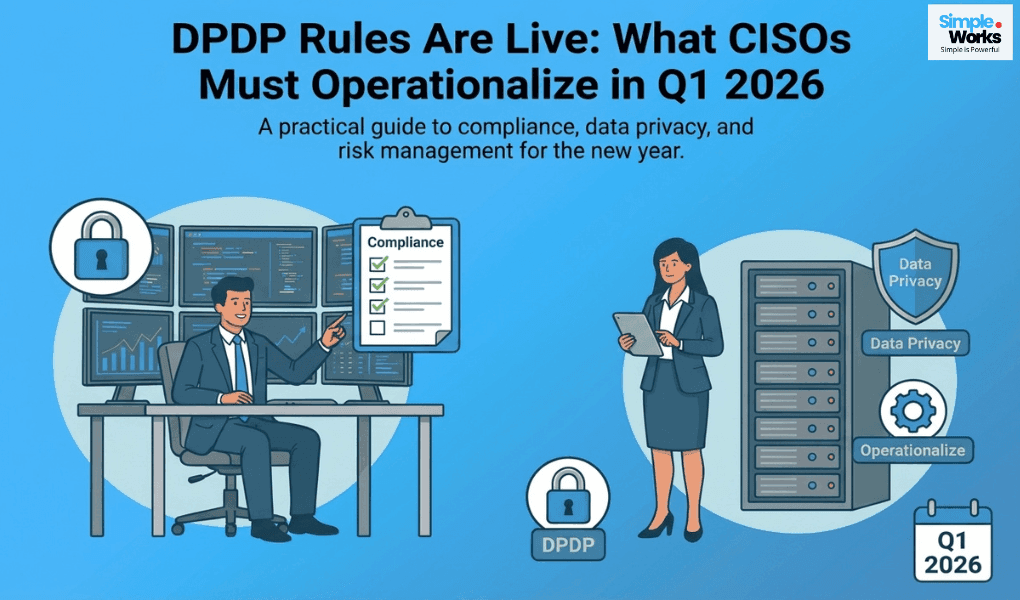
DPDP Rules Are Live: What CISOs Must Operationalize in Q1 2026
With India's Digital Personal Data Protection Rules now notified, CISOs at banks, insurers, and healthcare providers face an immediate operationalisation mandate.
RH
Rajan Harshey
SimpleWorks
KEY TAKEAWAYS
- India's DPDP Rules are live and the Data Protection Board is active — privacy has shifted from policy documentation to real-time operations.
- The 72-hour breach notification requirement is a multi-team coordination challenge across IT, Legal, Risk, Compliance, and Customer Support.
- Without predefined incident workflows, most organizations lose 24–36 hours just identifying who owns the affected data.
- Regulators will ask when the incident was detected, who was notified, what actions were taken, and where the evidence is stored.
DPDP is no longer a policy discussion. It's an execution challenge.
With India's Digital Personal Data Protection (DPDP) Rules now notified and the Data Protection Board of India actively operational, privacy has officially moved from documentation to real-time operations — especially for banks, NBFCs, and regulated enterprises. For CISOs and Risk Officers, the question in Q1 2026 is no longer "Are we compliant?" It's "Can we respond, prove, and report within 72 hours?"
Status Check: The Rules Are Live. Enforcement Is Real.
The DPDP framework has crossed a critical threshold: Rules notified, Data Protection Board active, clear timelines for breach reporting, and accountability shifting from intent to execution. Regulators will not ask whether you have a policy. They will ask: When was the incident detected? Who was notified? What actions were taken? Where is the evidence? If these answers live across emails, spreadsheets, and disconnected systems, your risk multiplies exponentially.
The Immediate Risk: The 72-Hour Clock Has Started
The most urgent operational risk under DPDP is breach notification within 72 hours. This is not just a reporting requirement — it's a massive coordination challenge involving IT & Security, Risk & Compliance, Legal, Customer Support, and Senior Management. Without predefined workflows, most organizations lose 24–36 hours just identifying ownership of the data.
From Playbooks to Practice: The "Red Button" Incident Workflow
What BFSI teams need now is not another policy document but a tested, repeatable incident workflow — what we call the "Red Button" Principle. At the moment of a suspected data incident, there must be one trigger, one workflow, and one system of record.
A practical incident response workflow should log the incident immediately (time-stamped and immutable), auto-alert relevant stakeholders, assign tasks across teams, and capture evidence continuously. Leading BFSI teams are integrating incident logging, task orchestration, and customer impact tracking into a single operational view rather than scattered tools.
Evidence Is the New Compliance Currency
Under DPDP, proof of action matters more than stated intent. Regulators will expect incident timelines, decision logs, communication records, customer notifications, and remediation steps. Manually compiling this after the fact is risky and error-prone.
- Automated Activity Logs: Every action taken by the system or human is recorded.
- Role-Based Approvals: High-stakes decisions require digital sign-off.
- Unified Context: SimpleWorks Customer360 centralizes customer data touchpoints with incident-related interactions, creating a living audit trail, not a retrospective one.
Privacy Is Now a Workflow, Not a Department
A critical shift in 2026: privacy is no longer owned by Legal or Compliance alone. It is executed daily by service agents handling customer data, sales teams accessing profiles, and IT teams integrating systems. Without guardrails built into workflows, risk leaks through human and system gaps. AI-assisted operations, contextual access, and controlled data views are essential, not optional.
Looking Ahead: Consent Managers (Nov 2026)
The next major milestone is the Consent Manager framework. Forward-looking organizations are already mapping consent dependencies, cleaning fragmented customer data, and preparing systems for dynamic consent enforcement. This is not a last-minute compliance task — it requires clean data, integrated systems, and operational discipline.
Final Thought: Stop Drafting Policies. Start Testing Protocols.
In 2026, privacy readiness will be measured by response speed and proof, not policy maturity. Have you run a mock data breach drill? Can you produce a full incident timeline in minutes? Do your teams know exactly what to do when the clock starts? DPDP is live. The only question is whether your operations are ready. Contact us at sales@simple.works.
SHARE
RELATED: SIMPLECRM COMPLIANCE SUITE
RBI & NBFC compliance automation — built into every workflow.
MORE BLOGS
REGULATORY INTELLIGENCE
The Clock Is Ticking: RBI's July 2026 NBFC Reclassification and What Every NBFC Leader Must Do Now
REGULATORY INTELLIGENCE
Did You Know the RBI Is Rewriting the Rules of Recovery Conduct in 2026?
REGULATORY INTELLIGENCE
The 2026 NBFC Consolidation: Why Your Tech Stack is Essential for Survival