CRM STRATEGY·5 min read·January 11, 2026
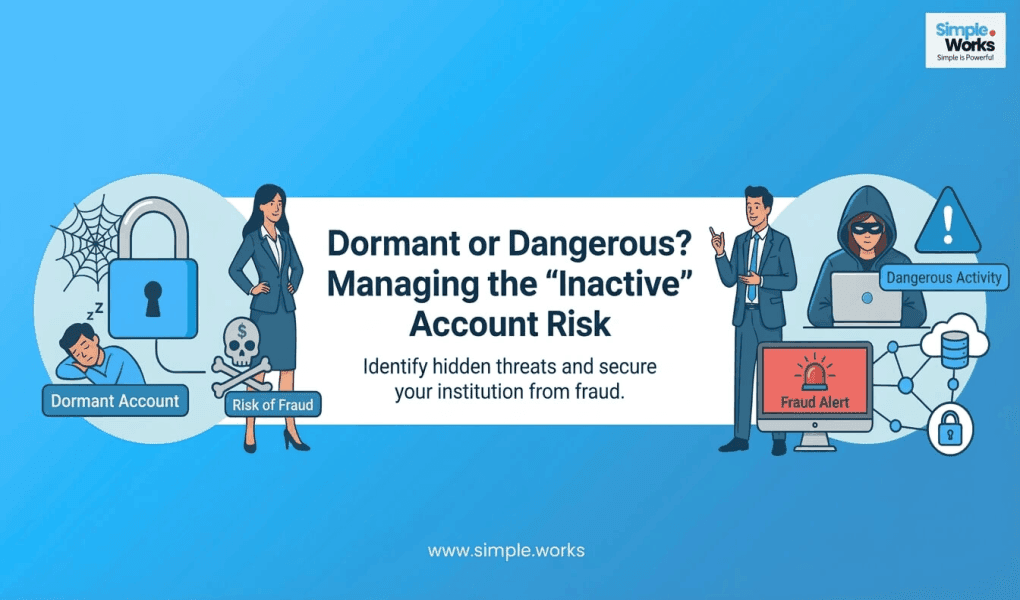
Dormant or Dangerous? Managing the "Inactive" Account Risk
For years, dormant accounts were an operational nuisance. Under DPDP and RBI's updated frameworks, they are a liability. Here is how to manage them systematically.
KK
Kunal Khedkar
SimpleWorks
KEY TAKEAWAYS
- RBI's January 2026 guidelines officially classify dormant accounts as a security threat requiring active management, not passive maintenance.
- Banks must proactively notify customers at the 12-month inactive mark and again before the 24-month inoperative reclassification.
- Dormant accounts are the preferred vehicle for money mule fraud rings — they carry vintage, history, and evade standard fraud models.
- Any account reactivated after two years now requires Enhanced Due Diligence rather than standard KYC verification.
For years, "dormant accounts" were an operational nuisance — a list of customers who stopped transacting, costing you maintenance fees. As of January 2026, they are officially a security threat.
With the RBI's new Account Hygiene Norms now in effect, the definition of a "healthy ledger" has changed. The regulator is no longer just asking "How many inactive accounts do you have?" They are asking: "Why are they still open, and who controls them?"
The Mandate: What Changed on January 26?
The RBI's updated 2026 guidelines have tightened the screw on account classification. The days of passive "bulk closures" are over.
- The Old Rule: Classify as "Inoperative" after 24 months. Freeze debits.
- Proactive Alerting: Banks must notify customers before the 12-month "Inactive" mark and again before the 24-month "Inoperative" mark.
- Zero-Liability Reactivation: Reactivation must be fee-free and digital-first.
- Mule Prevention: Any account reactivated after 2 years requires Enhanced Due Diligence (EDD), not just standard KYC.
The Risk: The "Mule" in the Haystack
Why the regulatory heat? Because dormant accounts are the preferred vehicle for Money Mules. Fraud rings don't open new accounts; they buy old ones. A savings account that has been "sleeping" for 18 months is the perfect Trojan Horse — it has a vintage, a history, and flies under the radar of standard fraud models — until sudden high-velocity transfers begin.
Consider the ops challenge: You have 5 million accounts and 15% are inactive. If you close them all, you lose 750,000 potential future customers. If you keep them open without checks, you invite regulatory penalties and fraud.
The Solution: Automated "Liveness" Journeys
You cannot solve this with a call center. Dialing 750,000 customers to ask "Are you still there?" is cost-prohibitive and low-yield. Leading banks are deploying Automated Re-KYC Journeys.
The "Nudge" Workflow (Months 10–12)
Instead of a generic "Use it or lose it" email, the system triggers a personalized engagement hook via WhatsApp or app notification: "Hi [Name], your card benefits are paused. Make one transaction of ₹1 to keep your lounge access active." This filters out the "Forgetful Savers" from the truly "Departed."
The "Safety Check" (Months 18–23)
For accounts approaching the "Inoperative" danger zone, the workflow shifts to security. The system prompts a "Liveness Check" via the banking app (FaceID or OTP). If the customer verifies, the timer resets. If they fail or don't respond, the account is auto-segmented into a "High-Risk/Freeze" bucket before a mule ring can attack.
Governance: The Audit Trail
The new 2026 norms require an audit trail of intent. Regulators will look for the "Decision Log": Why was Account X kept open despite a zero balance? Who authorized the reactivation of Account Y after 3 years? If your answer relies on manual email approvals, you are non-compliant. You need an orchestration layer that logs the re-KYC trigger, the customer's digital consent, and the system's automated validation in a single, immutable timeline.
Compliance Note: Zero Balance ≠ Inoperative
A crucial distinction in the Jan 26 rules: Zero Balance is a balance status — you cannot close an account solely for this without notice. Inoperative is a transaction status (24 months of silence). A zero-balance account receiving a government DBT (Direct Benefit Transfer) is active. Closing it triggers immediate grievance redressal penalties. Your system must distinguish an "Empty Wallet" from a "Ghost User."
The Verdict
The "Sleepy" account is no longer harmless. It is a dormant liability waiting to be weaponized. Convert your "Inactive" list into two clean piles: Recovered Customers and Safely Closed Files. Contact us at sales@simple.works.
SHARE
RELATED: SIMPLECRM ENTERPRISE PLATFORM
End-to-end CRM purpose-built for banks, NBFCs and insurers across 15+ countries.
MORE BLOGS
CRM STRATEGY
Your CRM Is Sitting on a Gold Mine of Branch Intelligence. Are You Mining It?
CRM STRATEGY
The Great Onboarding Paradox: Why "Frictionless" is the New Risk in 2026
CRM STRATEGY
SimpleCRM's BPM Engine: The Brain Behind Banking Operational Excellence